
Cat Ba Beyond · Activities
How Do Tides Affect Kayaking?
A kayaking route in Lan Ha Bay can feel completely different from one hour to the next. A cave entrance may become too low, a resting beach may disappear, and a gentle channel may develop a noticeable current. These changes are often caused by the tide rather than the weather.
Understanding the tide helps travellers see why kayaking times and locations sometimes change—even when the bay looks calm.
What is the difference between tide and tidal current?
The tide is the regular rise and fall of the water level, driven mainly by the gravitational influence of the Moon and Sun. That vertical movement also produces horizontal water movement known as a tidal current.
A rising tide is generally associated with water moving into bays and channels, while a falling tide moves water outward. However, current speed does not always change at exactly the same time as the water reaches high or low tide. Local geography can delay or redirect the flow.
This distinction matters in Lan Ha Bay because its channels, caves and enclosed lagoons have different shapes. Two nearby kayaking locations may experience different currents at the same time.
How does high tide affect kayaking?
High tide raises the water level, allowing kayaks to float across areas that may be too shallow at other times. It can provide easier access over submerged rocks and make some channels feel more open.
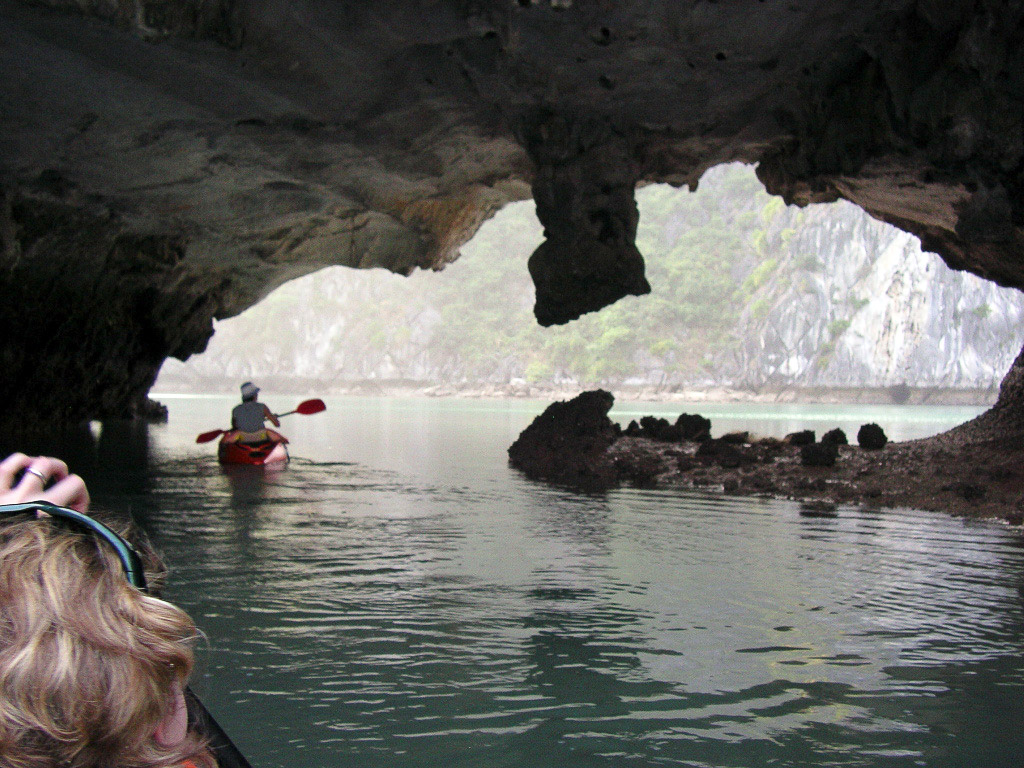
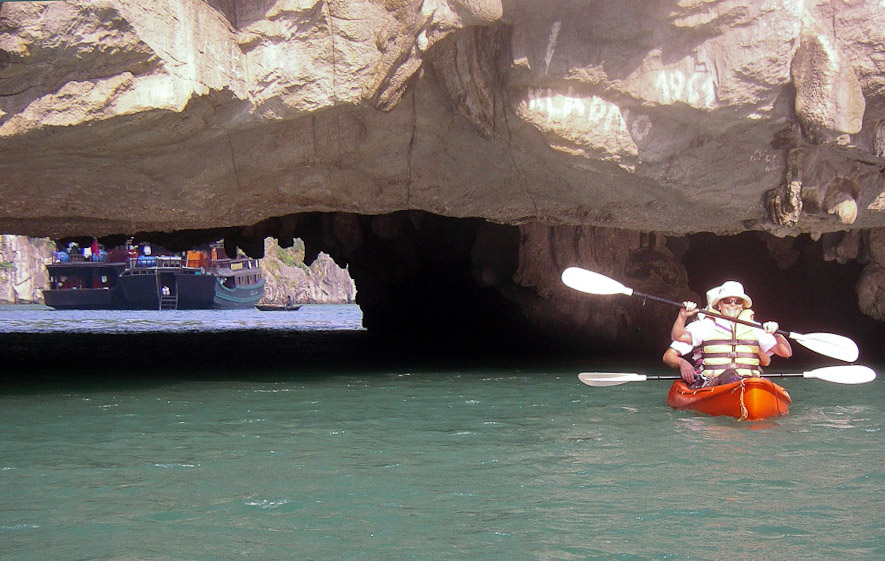
However, high water reduces the space between the surface and the roof of a low cave. An entrance that appears comfortable at mid-tide may become unsafe when the water rises.
Kayakers should never judge clearance from the entrance alone. A passage can become lower farther inside, and even a small wave can lift the kayak towards the ceiling.
What happens at low tide?
Low tide can create more headroom beneath natural arches and cave roofs. It may also reveal small beaches, tidal flats and rocky edges that remain underwater at high tide.
But lower water is not always better. Some entrances become too shallow to paddle through. A kayak can become stuck on mud, rocks or reef surfaces, and attempting to drag it may damage sensitive habitats.
Low tide can also make getting in and out of a kayak more difficult. Wet rocks and exposed steps may be slippery, while the distance between a boat platform and the water can increase.
Why do currents become stronger near caves?
When water is forced through a narrow cave or channel, it can accelerate. This is particularly noticeable when an enclosed lagoon fills or drains through a small opening.
A beginner may find it difficult to maintain direction, avoid the wall or paddle back against the current. Kayaks can also drift apart more quickly than expected.
Wind may strengthen the challenge. When wind and current move in opposite directions, the water can become short and choppy. This is why a route protected by limestone islands can still feel uncomfortable in a narrow passage.
Is slack water always at high or low tide?
Not necessarily. Slack water is a period when the horizontal tidal current becomes weak before changing direction. Many people assume that it always occurs at high or low tide, but the timing varies according to local geography.
NOAA notes that water level and current do not have a simple universal relationship. Therefore, checking only the time of high tide does not tell a visitor exactly how strong the current will be inside a particular Lan Ha Bay channel.
Local observation remains essential. An experienced guide combines tide information with the actual water movement, wind and ability of the group.
How do tides affect caves and lagoons?
Lan Ha Bay forms part of the Ha Long Bay–Cat Ba Archipelago, which UNESCO describes as an outstanding marine-invaded limestone karst landscape. Its features include caves, marine lakes and drowned depressions, some of which are influenced by tides.
Some enclosed lagoons can be reached only through low tunnels. Access may be possible for a limited period when there is enough water to float but sufficient space beneath the ceiling.
This window may occur around low, mid or rising tide depending on the shape of the passage. There is no single “best tide” for every cave.
Can tides change the itinerary?
Yes. A tour operator may alter the kayaking time, reverse the route or select another lagoon. This does not necessarily mean the itinerary was poorly organised.
Tide predictions help the crew plan, but wind, rain, waves, visibility and boat traffic also influence the final decision. A cave listed in the programme may be inaccessible when the group arrives, even though another kayaking area remains perfectly suitable.
A responsible guide should offer a safe alternative instead of forcing entry to fulfil a fixed promise.
Do tides make kayaking harder for beginners?
A sheltered route under suitable conditions can still be comfortable for a beginner. The difficulty increases when a current pushes the kayak sideways or when paddlers must travel against the flow.
Beginners should stay near the guide, avoid racing and maintain sufficient distance from other kayaks. If you stop to take photographs, check that the current is not carrying you towards rocks, a cave wall or boat traffic.
Children, weak swimmers and nervous paddlers should choose a short route close to the support boat. Everyone must wear a correctly fastened life jacket.
How can visitors prepare?
You do not need to calculate the tides yourself on a guided tour, but useful questions include:
- Is today’s route affected by the tide?
- Will the group enter any low caves?
- Is the current suitable for beginners?
- Could the kayaking location change?
- Where will the support boat remain?
- What signal means the group should return?
Never enter an unfamiliar cave independently or follow another kayak merely because it passed successfully. Water levels and currents continue changing, and the other paddlers may have different experience or instructions.
The best tide is the safest tide for that route
High tide, low tide and mid-tide can each offer advantages. The correct choice depends on the location, current, weather and group.
Rather than searching for one perfect tidal stage, choose a licensed operator with guides who understand the bay. The best kayaking experience is not necessarily the one that reaches every cave—it is the one planned around the conditions Lan Ha Bay provides that day.